Securing Security - DANE Introduction
Why "Securing Security"
Modes of encryption
- opportunistic encryption
- mandatory encryption
Opportunistic encryption
- No expectation (we take what we get)
- Encryption only if available
- No alerting if encryption fails
Mandatory encryption
- Encryption required
- Abort and alarm in case encryption is failing
- Authentication of the communication peer
- Abort and alarm in case the identity of the peer can not be verified
Issues with opportunistic encryption
- Weaknesses of the Certification Authority (CA) model
- Downgrade attacks are possible
- MITM (Men in the Middle) attacks are possible
- When using certificate pinning, fully automatic certificate rollover are not possible
Problems of the PKIX system (Internet CA model)

- Every CA can issue certificates for every domain
- Sloppy security practices by some CA - the CA model is as secure as its weakest link
- Some CAs are operated by non-trustworthy actors
- CAs sometimes issue wrong or un-authorized certificates
Türktrust? Diginotar? StartSSL? Symantec?
Email encryption session downgrade
- STARTTLS works without a policy channel
- STARTTLS support of a peer is unknown before the connection attempt
- Attacker can strip the STARTTLS command from the unencrypted connection and downgrade the session to "Non-TLS"
Email encryption session downgrade
220 mail.example.com ESMTP
EHLO client.example.com
250-mail.example.com
250-PIPELINING
250-SIZE 409600000
250-ETRN
250-STARTTLS
250-ENHANCEDSTATUSCODES
250-8BITMIME
250 DSN
Session Downgrade
In recent months, researchers have reported ISPs in the US and Thailand intercepting their customers' data to strip a security flag— called STARTTLS—from email traffic. (…) By stripping out this flag, these ISPs prevent the email servers from successfully encrypting their conversation, and by default the servers will proceed to send email unencrypted.
https://www.eff.org/deeplinks/2014/11/starttls-downgrade-attacks
MITM Attacks
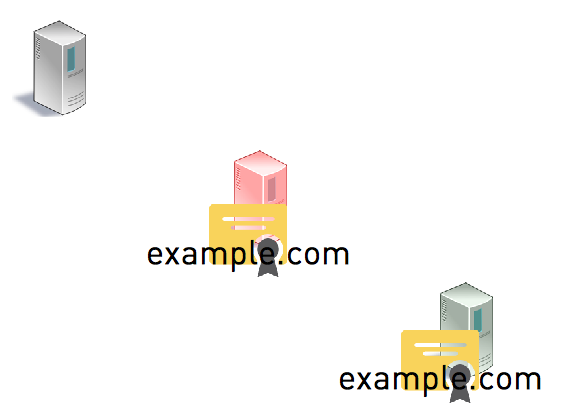
- Attacker break TLS secured connections with a matching certificate
(matching
Common Name) - Most MTA (mail server) accept self-signed certificates (validation of peer identity is not possible)
Missing automation
- Manual validation of certificates for certificate pinning
- Validation of certificates needs knowledge
- Validation of certificates requires work by a human
- Certificate changes at the peer must be monitored
- Manual certificate pinning does not scale
Securing Security
The Plan
- Add a trusted policy channel to TLS
- Build a trust chain
- Signal encryption ability
- Communicate identity
Welcome to DANE
DANE = "DNS-based Authentication of Named Entities" (RFC 6698)
- DANE uses and requires DNSSEC
- DNS is the (new) communication channel for policy information
- DNSSEC enables the trust relationship
- DNS records signals the ability for TLS encryption
DANE Use-cases
- SMTP - binds service/server to one or more x509 certificates
- HTTP - binds service/server to one or more x509 certificates
- IPSEC - publishes the IPSec encryption configuration for a host
- OpenPGP - connects a public PGP/GPG key to an email address
- S/MIME - binds an email address to x509 certificates
- DoH/DoT - provides authentication for DNS encryption
Other options to secure TLS connections
DANE is not the only technology that aims to improve the security of the Internet PKI (PKIX):
- Certificate Transparency - provides an immutable log of issued certificates - can be used to detect misuse of the CA system (after the fact)
- CAA-Record - publishes a policy that binds a domain to one or more certification authorities (CA)
TLS Key Pinning
- Key Pinning
- HPKP - HTTP Public Key Pinning - RFC 7469 (deprecated)
- MTA-STS - SMTP MTA Strict Transport Security - RFC 8461
- Key Pinning had issues and is not widely deployed
- Qualsys: HKPK is dead
- Google Chrome has removed HKPK in Version 78 (Current Version is 118)
Deprecate support for public key pinning (PKP) in Chrome, and then remove it entirely.
DNS as a policy channel
DNS as a policy channel
- DNS has been developed in 1983 as an lightweight, networked hierarchical database for Internet infrastructure information
- DNS has been used mostly for name and address lookups in the early years
- DNS is now becoming the preferred channel to publish security policy information for Internet services
DNS as a policy channel
; <<>> DiG 9.16.44-Debian <<>> txt microsoft.com
;; global options: +cmd
;; Got answer:
;; ->>HEADER<<- opcode: QUERY, status: NOERROR, id: 13974
;; flags: qr rd ra; QUERY: 1, ANSWER: 16, AUTHORITY: 0, ADDITIONAL: 1

;; QUESTION SECTION:
;microsoft.com.			IN	TXT

;; ANSWER SECTION:
microsoft.com.		3568	IN	TXT	"google-site-verification=pjPOauSPcrfXOZS9jnPPa5axowcHGCDAl1_86dCqFpk"
microsoft.com.		3568	IN	TXT	"fg2t0gov9424p2tdcuo94goe9j"
microsoft.com.		3568	IN	TXT	"t7sebee51jrj7vm932k531hipa"
microsoft.com.		3568	IN	TXT	"google-site-verification=M--CVfn_YwsV-2FGbCp_HFaEj23BmT0cTF4l8hXgpvM"
microsoft.com.		3568	IN	TXT	"google-site-verification=GfDnTUdATPsK1230J0mXbfsYw-3A9BVMVaKSd4DcKgI"
microsoft.com.		3568	IN	TXT	"d365mktkey=SxDf1EZxLvMwx6eEZUxzjFFgHoapF8DvtWEUjwq7ZTwx"
microsoft.com.		3568	IN	TXT	"hubspot-developer-verification=OTQ5NGIwYWEtODNmZi00YWE1LTkyNmQtNDhjMDMxY2JjNDAx"

;; Query time: 1097 msec
;; SERVER: 100.115.92.193#53(100.115.92.193)
;; WHEN: Tue Oct 17 09:35:22 CEST 2023
;; MSG SIZE  rcvd: 512
Examples of DNS based policy data
- DANE (TLS policy via DNS - the topic of our workshop)
- CAA (Restricting certificate issuing)
- DKIM/DMARC/SPF (Email security)
- Authentication token for internet services (the TXT records at the domain root)
- HTTPS Records (Public key for TLS "encrypted client hello")
- MTA-STS (SMTP-TLS policy via HTTPS)
- SSHFP (SSH fingerprints)
- IPSec (IPSec configurations)
Security of DNS based policy data
- The original DNS system has no build-in security
- Attacking DNS data is not hard (cache poisoning, DNS spoofing)
- DNS data might be communicated by untrusted parties (operators for secondary services, insecure DNS resolver caches)
- DNSSEC adds authentication and integrity proof to DNS
- Recipients of DNS data can validate the origin and the content of the DNS data
The need for DNSSEC
- Policy data in DNS demands DNSSEC
- DANE requires DNSSEC to work
- Operating other DNS based policy methods without DNSSEC severely weakens the security of these policy methods
DNS based policy data without DNSSEC is like having a strong secured iron door inside a paper wall.
End
Questions ? Answers!