TLS Reporting (TLSRPT)
Carsten Strotmann - Patrick Koetter, sys4 AG
Created: 2023-10-31 Tue 12:17
TLSRPT
The problem
- Detecting issues with SMTP transport security can be difficult
- The issues are only visible on the sending side
- The issues might be present on the receiving side
The solution
- TLS Reporting (TLSRPT, RFC 8460 Standards Track) defines a protocol for communicating TLS issues from a sending MTA towards the operator of the receiving MTA
- TLSRPT helps finding issues with both DANE (RFC 6698 Standards Track) and MTA-STS
(RFC 8461 Standards Track)
- failures in routing
- failures in DNS resolution
- failures in TLS/STARTTLS negotiation
- TLSRPT works very similar to DMARC (RFC 7489 Standards Track) reporting
How TLSRPT works
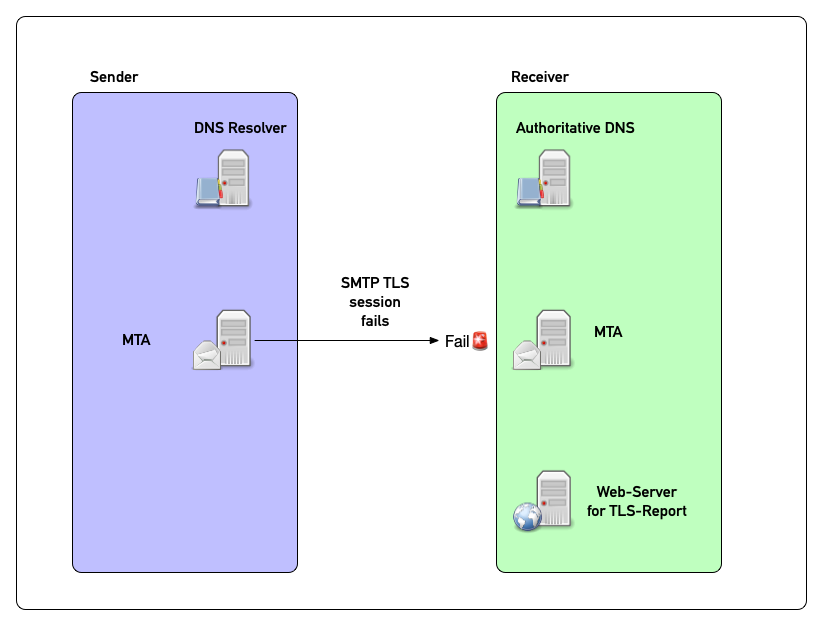
TLSRPT in pictures (1)
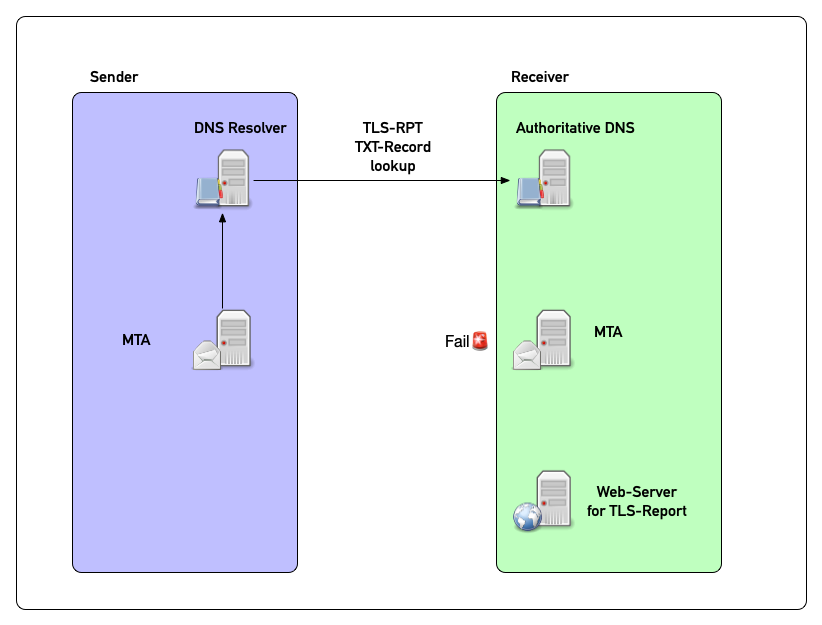
TLSRPT in pictures (2)
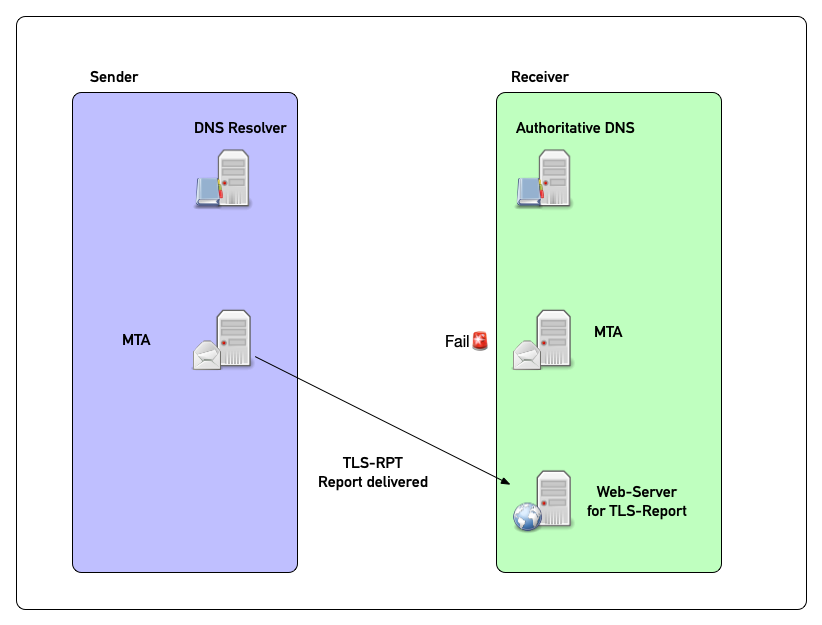
TLSRPT in pictures (3)
TLSRPT DNS Record
- The TLS reporting policy is published with a DNS TXT record at the
DNS label
_smtp._tlsat the mail domain. For the mail-domainexample.orgthe domain name for the TXT record would be_smtp._tls.example.org.
TLSRPT record values
- The TLSRPT record contains key/value-pairs (separated by semicolon):
- v: TLSRPT version number, current value
TLSRPTv1 - rua: Reporting URI, either of type mailto (report via SMTP mail) or https (HTTP-Post). There can be multiple rua values in the TLSRPT TXT record
- v: TLSRPT version number, current value
Example TLSRPT
; <<>> DiG 9.16.44-Debian <<>> _smtp._tls.google.com txt
[...]
;; ANSWER SECTION:
_smtp._tls.google.com.	360	IN	TXT	"v=TLSRPTv1;rua=mailto:sts-reports@google.com"
TLSRPT report format
TLSRPT report format
- The TLSRPT aggregate reports are send as compressed (gzip) JSON
documents (
application/tlsrpt+jsonmime type) - Each aggregated report should cover 24 hours (the reporting software needs to collect TLSRPT data for this time to generate the reports)
TLSRPT metadata
- The TLSRPT aggregate report contains metadata
- Information on the organization sending the report
- Contact information for the responsible operators for the content of the report
- A unique identifier for the report
- The date range contained in the report
TLSRPT policy data
- Applied policy
- DANE, including the used TLSA records
- MTA-STS, including the content of the MTA-STS policy document
- The text
no-policy-foundif neither DANE nor MTA-STS have been found
- The MX host where the TLS issue has been found
- The mail domain where the issue has been seen
- Aggregate counts of issues
TLS negotiation failure types reported
| Reported failure | Description |
|---|---|
| starttls-not-supported | Receiver does not offer STARTTLS |
| certificate-host-mismatch | Domain name(s) in the receiving MTA certificate do not match the DNS name of the MTA |
| certificate-expired | The certificate is expired |
| certificate-not-trusted | The certificate does not contain a valid trust chain towards a trusted root CA |
| validation-failure | The certificate could not be validated |
DANE negotiation failure types reported
| Reported failure | Description |
|---|---|
| tlsa-invalid | The TLSA record found in DNS is invalid |
| dnssec-invalid | The DNSSEC validation on the TLSA record failed |
| dane-required | The sending MTA is configured to require mandatory DANE security for this mail destination. Mandatory DANE for SMTP is described in Section 6 of RFC7672 |
MTA-STS negotiation failure types reported
| Reported failure | Description |
|---|---|
| sts-policy-fetch-error | The MTA-STS policy cannot be loaded from the web server (document does not exist or other http error) |
| sts-policy-invalid | The MTS-STS policy document cannot be parsed, it is invalid |
| sts-webpki-invalid | The TLS connection to the web-server containing the MTA-STS document cannot be established |
Implementing TLSRPT
TLSRPT security
- To prevent resource exhaustion attacks on mail infrastructure, the reporting part for TLSRPT should be decoupled from the sending mail server infrastructure
- Reports should be collected and send as a batch to the receiving side to not overload the receiving infrastructure
- TLSRPT does not require DNSSEC security for the TXT-Record
- TLSRPT reports send by email must be DKIM signed (to build reputation on reports)
TLSRPT privacy
- Reporting can leak sensitive information
- Failure reports from the sender to the receiver can leak internal information on the TLS implementation and the MTA product being used
- Information about the senders email address or even part of the message might end up in the reporting
- TLSRPT reporting functions of MTAs should be evaluated for possible privacy issues
TLSRPT implementations
- Open Source:
- together with Wietse Venema (Postfix), sys4 is currently developing a low-level C library that can be integrated into any MTA (Postfix, Sendmail, Exim, …) as well as TLSRPT data receiver and reporter services that can aggregate TLSRPT report data, process it into a report and transmit it. (ETA Q1 / 2024)
- DMARC & SMTP-TLS Reports processor and visualizer: https://github.com/antedebaas/DMARC-SMTPTLS-Reports
- Simple python script to process TLSRPT reports https://github.com/Comcast/tlsrpt_processor
TLSRPT implementations
- All large mail platforms (gmail, microsoft, yahoo, …) have implemented TLSRPT
External TLSRPT services
- DMarcian
- PowerDMARC
- Redshift
- and more
End
Questions? / Answers!